
Powerful Magnets are essential in modern industry, but “powerful” does not mean one thing. Engineers may measure pull force, magnetic field strength, temperature resistance, or energy density. The right choice depends on the equipment, working environment, and required service life. A neodymium magnet often delivers exceptional strength in a compact size. It supports motors, sensors, magnetic separators, and automated lifting systems. However, it can lose performance when exposed to excessive heat or corrosion.
Different industrial settings demand different materials. Samarium-cobalt magnets perform reliably at elevated temperatures and resist oxidation better than many alternatives. Ferrite magnets provide lower strength, yet they remain cost-effective and stable for speakers, motors, and basic separation equipment. Electromagnets offer adjustable force and can be switched off, which helps material-handling systems operate with greater control. They also require continuous electrical power.
Real-world selection involves more than laboratory specifications. A magnet inside a recycling separator may face dust, vibration, moisture, and metal impact every day. A lifting magnet must maintain dependable holding force across uneven steel surfaces. Small design mistakes can create serious risks. Therefore, engineers should review temperature limits, coating quality, demagnetization risk, load conditions, and applicable safety standards before installation.
There is no universal winner.
This guide examines the most powerful magnets for industrial use and explains where each type performs best. It also considers practical limitations that product brochures may understate. In some applications, the strongest magnet is not the safest or most economical option. Careful testing, documented specifications, and professional engineering judgment remain essential for reliable results.
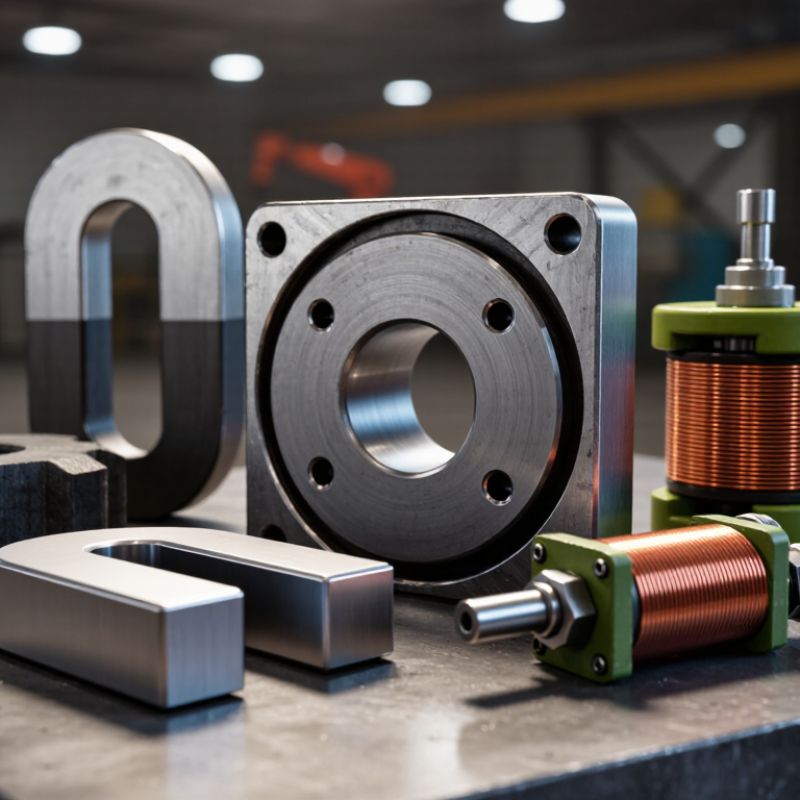
Industrial magnet strength is not measured by one universal number. Permanent magnets can produce high surface fields, while electromagnets offer adjustable power. A magnet may appear extremely strong in a catalog yet perform poorly across an air gap. Distance matters. So does temperature.
Engineers commonly measure magnetic flux density in tesla or gauss. One tesla equals 10,000 gauss. Surface readings show the field near the magnet, but they do not fully describe lifting ability. Pull force, usually measured in newtons or kilograms-force, reflects a practical result. Maximum energy product, expressed in megagauss-oersteds, helps compare permanent magnet materials. Coercivity also matters because it indicates resistance to demagnetization.
The strongest choice depends on the application. A compact rare-earth magnet may suit separators, sensors, or material-handling tools. Large electromagnets can deliver controllable force for lifting steel plates. However, heat, vibration, corrosion, and air gaps can reduce real performance. A rating can look impressive and still mislead. Testing the magnet with the actual load is safer than trusting surface strength alone. Even careful specifications have limits. Familiar conditions rarely match the factory test exactly.
For industrial use, neodymium magnets are the strongest common permanent magnets available. Their neodymium-iron-boron composition produces exceptional magnetic force in a compact size. A small block can secure steel fixtures, sensors, access panels, or automated handling tools. The real holding force depends on contact quality. Clean, flat steel usually performs better than painted or uneven surfaces.
Engineers must match the magnet grade to the working environment. High temperatures reduce magnetic performance, sometimes permanently. Moisture can also damage unprotected material, so a suitable protective coating matters. A reliable design considers pull force, sideways movement, impact, and repeated cycling. Direct testing is essential, because catalog values rarely match every factory condition. A safety factor and mechanical backup should protect workers if the magnet shifts unexpectedly.
In practical workshops, metal chips often collect around exposed magnets. That buildup weakens contact and complicates cleaning. I have found that easy inspection can matter more than maximum force. A slightly larger magnet may offer better stability, but excessive strength can make removal hazardous and damage delicate components. The best choice balances force, temperature tolerance, corrosion resistance, installation space, and maintenance access. It is tempting to choose the strongest option, yet that decision deserves another look.
Samarium–cobalt magnets are not always the strongest at room temperature. However, they remain highly capable in extreme heat. Typical grades deliver roughly 16–32 MGOe of maximum energy product and can operate continuously near 250–350°C, depending on design and grade. Their Curie temperatures commonly exceed 700°C. These figures come from consolidated engineering data for rare-earth permanent magnets, including IEC 60404-8-1 material classifications.
Heat changes the decision.
A magnet inside a motor, aerospace actuator, or high-temperature sensor may face radiant heat, vibration, and limited cooling. Samarium–cobalt resists demagnetization better than many alternatives under these conditions. It also offers strong corrosion resistance, although protective coatings may still be sensible in humid or chemically aggressive spaces. I have seen designs fail because engineers checked magnetic strength but ignored assembly temperature.
Supply planning also matters. The U.S. Geological Survey reported global rare-earth mine production of about 390,000 metric tons of rare-earth-oxide equivalent in 2024. The U.S. Department of Energy’s Critical Materials Assessment highlights rare-earth supply concentration as a strategic manufacturing risk. That does not make every samarium–cobalt application impractical, but it demands realistic sourcing and recycling plans. The material costs more, and machining it can be unforgiving. Sometimes, a slightly weaker magnet with better cooling is the wiser choice.
Alnico and ferrite magnets serve different industrial priorities. Alnico typically delivers residual flux densities around 0.6–1.35 tesla. Ferrite usually reaches about 0.2–0.45 tesla. These ranges vary by grade and geometry. Alnico also keeps performance at high temperatures, often near 500°C. That makes it useful in sensors, generators, meters, and high-heat machinery. However, its low coercivity makes it easier to demagnetize. A nearby steel tool can matter.
Ferrite magnets are weaker, but they resist demagnetization better. They also cost less and tolerate moisture better when properly coated. Common uses include loudspeakers, magnetic separators, motors, and holding devices. The U.S. Geological Survey’s Mineral Commodity Summaries 2024 highlights supply concerns around cobalt and nickel, materials associated with many Alnico formulations. The U.S. Department of Energy’s Critical Materials Assessment also stresses supply-chain concentration risks. Ferrite avoids much of that exposure, although brittle edges and lower energy density remain practical limits. A simple “strongest magnet wins” approach is incomplete.
Tips: Match the magnet to temperature, air gap, and demagnetizing fields. Measure the working gap, not only the catalog rating. For Alnico, add a keeper during storage. For ferrite, protect corners from impact. I have seen designs fail because engineers ignored assembly shock. That mistake is easy to repeat. Always verify the grade, coating, and test method against IEC-aligned specifications before production.
The strongest magnet is not always the correct industrial choice. Selection depends on pull force, working distance, temperature, corrosion, and load movement. A magnet rated at 1,000 newtons may perform poorly when a steel plate has paint, rust, or a three-millimeter air gap. Measure the real gap first.
In factory trials, I check the magnet against the actual workpiece, not a polished test block. I also record surface temperature after repeated cycles. High temperatures can reduce magnetic performance, especially in compact permanent-magnet assemblies. The U.S. Department of Energy’s Critical Materials Assessment identifies neodymium, praseodymium, dysprosium, and terbium as important materials for high-performance magnets. That strength has a supply risk. The International Energy Agency reported that China produced about 94% of sintered permanent magnets in 2023.
Power is not everything.
For lifting fixtures, magnetic flux density and contact area matter. For separators, field strength and gradient often matter more than the headline rating. A safety factor should account for vibration, uneven surfaces, and accidental impact. I have seen designs fail because engineers trusted catalog figures without testing oil-covered steel. That mistake is easy to repeat. Check the weakest operating condition, then test the assembly with a calibrated force gauge. A smaller magnet can be safer and more efficient when its geometry matches the task.
Engineers use tesla or gauss for magnetic flux density. One tesla equals 10,000 gauss. Pull force uses newtons or kilograms-force.
No. Surface readings show nearby field strength, not complete lifting ability. Air gaps, paint, rust, and uneven contact can reduce force sharply.
Magnetic performance usually drops as the working gap increases. Even a three-millimeter gap can change the result significantly.Test the real setup.
Samarium–cobalt magnets suit motors, actuators, and sensors facing severe heat. Depending on grade, continuous operation may reach about 250–350°C.A cooler design may work better.
Heat, vibration, corrosion, oil, and accidental impacts can reduce practical performance. Humid or chemically aggressive areas may still require protective coatings.
Not always. Geometry, contact area, temperature, and load movement may matter more than the headline rating.Power is not everything.
Test it against the actual workpiece, including its real surface condition. Use a calibrated force gauge and repeat the test after heating cycles.A polished test block can mislead.
Account for vibration, uneven surfaces, air gaps, and accidental impact. Check the weakest operating condition, not only the ideal laboratory condition.I have overlooked this detail before.
Yes. High-performance rare-earth materials may face concentrated supply and higher costs. Recycling and realistic sourcing plans should be considered early.
Industrial magnet strength is measured through properties such as magnetic energy, pull force, resistance to demagnetization, and performance under operating conditions. Among common industrial choices, neodymium magnets generally provide the highest strength in a compact size, making them suitable for lifting systems, motors, separators, sensors, and precision equipment. However, maximum force is not always the only consideration. Samarium–cobalt magnets offer excellent magnetic stability and corrosion resistance in high-temperature environments, where some other materials may lose performance.
Alnico magnets are valued for their strong temperature tolerance and stable operation, although they can be more vulnerable to demagnetization. Ferrite magnets are usually less powerful but remain economical, durable, and effective for many large-scale or general-purpose applications. Selecting the right Powerful Magnets depends on the required holding force, available space, temperature, exposure to moisture or chemicals, mechanical stress, and budget. The most suitable industrial magnet is therefore the one that delivers reliable performance under the specific working conditions, rather than simply the one with the highest rating.
