
Large Magnets are not simply oversized pieces of metal. They are engineered systems that create strong, controlled magnetic fields for lifting, separation, motors, generators, medical equipment, and industrial automation. Their performance depends on magnetic material, geometry, temperature, surface condition, and air gap. A magnet can look impressive yet perform poorly across a wide gap. That detail is often overlooked.
Permanent magnets, especially neodymium-iron-boron (NdFeB) types, contain aligned magnetic domains. These microscopic regions act like many small compass needles pointing in similar directions. Their combined field can pull steel parts across a workshop floor or hold a component inside a motor. Electromagnets work differently. Electric current travels through a coil, producing a magnetic field that can be switched, adjusted, or reversed. Simple in principle. Demanding in practice.
Industry reports show why these technologies matter. The International Energy Agency’s Global Critical Minerals Outlook 2024 highlights rising demand for rare earth elements used in permanent magnets, driven by electric vehicles, wind turbines, and advanced motors. The U.S. Geological Survey’s Mineral Commodity Summaries 2024 also identifies rare earths as strategically important materials, while noting concentrated global supply chains. Grand View Research reports continued expansion in the global permanent magnet market, although market estimates vary by definition and region. That uncertainty deserves attention.
This guide explains how Large Magnets generate force, how engineers measure their strength, and why design choices affect reliability. We will examine magnetic flux, field intensity, holding force, heat resistance, and safe handling. Real-world performance is never determined by size alone. Sometimes, smaller magnets win.
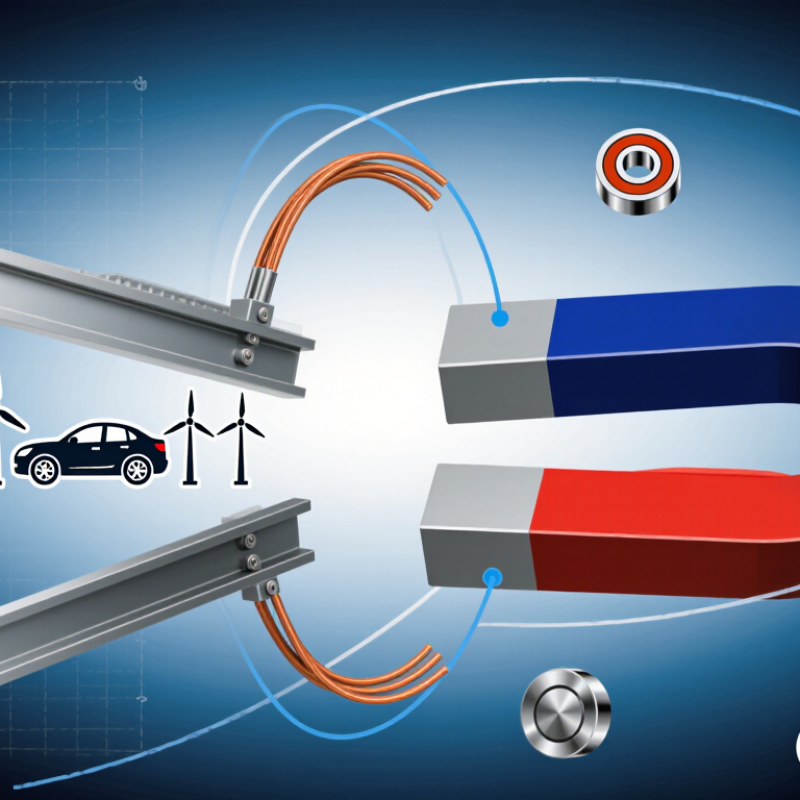
Large Magnets and Their Classification
Large magnets are materials or devices that create a strong magnetic field across a considerable distance. “Large” does not mean one fixed size. Engineers may classify a magnet by mass, surface area, lifting force, or magnetic field strength. A flat plate weighing several kilograms can be large physically, while a smaller research magnet may produce a stronger field.
Material is a practical classification. Permanent magnets include ferrite, neodymium-based alloys, samarium-cobalt, and alnico. Ferrite magnets are generally affordable and resist corrosion. Neodymium-based magnets provide high strength in compact volumes, but they can chip easily. Samarium-cobalt performs well at elevated temperatures. Alnico handles heat effectively, although its magnetic strength is usually lower. These differences matter during design.
Shape also changes performance. Blocks, rings, discs, and custom assemblies guide magnetic flux in different ways. A ring magnet can create a central opening for shafts or sensors. A block magnet may deliver a broad holding surface. Electromagnets form another major class. They use coils and electrical current, so operators can control their force. They also lose magnetism when power stops, unless a permanent magnetic core remains.
Classification is useful, but never perfect. Real equipment often combines materials, shapes, and operating methods. In a workshop, a magnet’s measured pull may differ from its catalog estimate because of air gaps, surface coatings, temperature, and steel thickness. Small details matter. Safe handling requires controlled movement, protective barriers, and careful checks for nearby electronic devices.
Large magnets begin with material choice. Permanent magnets use hard magnetic alloys that resist losing their magnetism. Rare-earth compounds can create strong fields from relatively small volumes. They stay magnetized. Ceramic magnets cost less but usually provide weaker fields. Electromagnets use copper coils wrapped around an iron or steel core. When electric current passes through the coil, it creates a magnetic field. The core strengthens and guides that field. Turn off the power.
A large magnet’s field is invisible, but its effects are measurable. Field strength changes with distance from the poles. Pole shape also matters. A wide face may spread force across a larger area. A narrow pole can concentrate attraction in one location. In lifting equipment, engineers calculate load, air gap, and steel thickness. Even a thin layer of paint can reduce holding force. In medical imaging systems, carefully shaped coils produce a stable field around a patient. Shielding limits unwanted effects nearby.
Reliable operation requires more than a strong material. Technicians use calibrated meters and documented procedures. They check loose tools, cables, and nearby steel parts. Small objects can move suddenly. Heat increases electrical resistance in coils. Cooling systems therefore protect high-current magnets. A simple explanation can miss this detail. Field models guide design, but measurements remain essential. I would not treat a magnet’s rated force as universal. Real conditions often disagree.
Representative magnetic flux densities show how different materials and magnet technologies generate magnetic fields. Permanent magnets rely on aligned magnetic domains, while electromagnets and superconducting magnets produce fields by driving current through coils.
Values are representative field strengths in teslas (T). Actual performance depends on magnet geometry, air gap, temperature, coil design, and measurement location.
Large magnets control force by shaping magnetic fields, not by simply increasing size. Permanent magnets use aligned magnetic domains, while electromagnets create fields through electric current. Around a straight conductor, current produces a circular field. In a coil, those fields combine and strengthen. Adding an iron core concentrates the flux, creating a stronger pulling force.
Force depends on field strength, current, geometry, and distance. For an electromagnet, the relationship F = BIL helps estimate force on a current-carrying conductor. Magnetic pressure also rises with the square of flux density.
This matters in lifting systems, generators, particle equipment, and medical scanners. The National Institute of Biomedical Imaging and Bioengineering reports that many MRI systems operate at 1.5 or 3 tesla. That field must be carefully directed, because nearby steel can move suddenly. Large magnet assemblies use pole pieces, steel yokes, shielding, and adjustable coils to guide force toward a target. Real systems leak flux. The model is never perfect.
Tips:
Measure the air gap first. A small gap can change force dramatically. Check heat, vibration, and coil insulation during operation. Use a calibrated gaussmeter, not visual judgment. The U.S. Geological Survey’s Mineral Commodity Summaries 2025 reports about 390,000 metric tons of rare-earth-oxide-equivalent mine production in 2024. That supply supports many high-performance permanent magnet applications, but material quality and design still determine actual performance. Oversizing a magnet may waste energy, increase risk, and reduce controllability.
Large magnets are engineered devices that create strong, controlled magnetic fields. Permanent magnets use hard magnetic materials, such as neodymium-iron-boron or ferrite. They keep their magnetism without continuous power. Electromagnets use copper coils and an electric current. Their strength can be adjusted, switched, or reversed. Superconducting magnets create extremely intense fields with very low electrical resistance, but they require cryogenic cooling.
The main types serve different industrial needs. Permanent magnets drive electric motors, generators, speakers, magnetic couplings, and compact sensors. Large electromagnets lift steel slabs, separate metal particles, and control material flow in recycling plants. Superconducting systems support medical imaging and scientific instruments. According to the U.S. Geological Survey’s Mineral Commodity Summaries 2024, global rare-earth mine production reached about 350,000 metric tons in 2023. That supply supports many high-performance permanent magnets, although mining output does not equal finished magnet capacity.
Wind turbines and electric vehicles increasingly use powerful permanent magnets because they can deliver high torque in smaller packages. The International Energy Agency’s Global Critical Minerals Outlook 2024 identifies magnet rare earths as a fast-growing demand area linked to clean-energy technologies. The exact growth rate depends on design choices and recycling. It is not perfectly predictable. Large magnets also require careful shielding, temperature control, and mechanical restraint. A field invisible to the eye can pull tools across a workshop. Small mistakes become expensive.
Large magnets generate intense magnetic fields that attract ferrous objects and can store substantial mechanical energy. Their force changes sharply with distance, so a small gap may disappear suddenly. The ACR Manual on MR Safety (2024) identifies projectile incidents as a major hazard around strong magnetic fields. Keep tools, gas cylinders, phones, and loose steel parts outside controlled areas. Use marked exclusion zones, physical barriers, and trained personnel.
Control the load before moving it. Rated lifting equipment, secondary restraints, and nonmagnetic tools reduce unexpected movement. Never place fingers between a magnet and a steel surface. OSHA’s Lockout/Tagout fact sheet estimates that proper energy isolation prevents about 120 deaths and 50,000 injuries annually in the United States. That principle also matters during magnet maintenance: isolate electrical systems, secure moving assemblies, and verify zero stored motion before inspection. Labels help, but they are not a control.
Maintenance should include checking cracks, chipped coatings, corrosion, loose fasteners, cable damage, and abnormal heating. Follow the manufacturer’s field-strength and temperature limits. A calibrated gaussmeter can confirm field boundaries after installation or repair. Keep inspection records with dates, measurements, and corrective actions. A clean surface is not necessarily a safe surface. I still treat every handling plan as provisional, because magnet force can defeat an apparently careful setup. Near misses deserve review, even when nobody is injured. (ACR Manual on MR Safety, 2024; OSHA Lockout/Tagout Safety and Health Topics, accessed 2024.)
| Topic | Parameter or Dimension | Typical Facts and Values | How It Works or Why It Matters | Safety, Handling, and Maintenance Guidance |
|---|---|---|---|---|
| Definition | Meaning of “large magnet” | There is no single internationally fixed size or weight threshold. A magnet is generally considered large when its mass, dimensions, magnetic field, or attraction force requires mechanical handling and controlled access. | Risk depends on more than physical size. A compact neodymium magnet can create a stronger local attraction than a much larger ferrite magnet. | Assess mass, field strength, stored magnetic energy, pinch points, nearby equipment, and the magnet’s intended use before moving it. |
| Magnetic principle | Magnetic field and force | A magnet produces a magnetic field, commonly measured in tesla (T) or gauss (G). 1 tesla = 10,000 gauss. | Magnetic force increases with field strength, magnetic material, pole geometry, air-gap reduction, and the properties of the attracted object. | Never estimate lifting capacity from size alone. Use the manufacturer’s tested rating or a qualified engineering calculation with an appropriate safety factor. |
| Permanent magnet material | Neodymium-iron-boron (NdFeB) | Very high magnetic energy density; many common grades have maximum operating temperatures around 80°C, while specialized grades can be rated above 200°C. | Provides strong attraction in a relatively small volume, making it useful for lifting, motors, generators, sensors, and magnetic separation. | Protect from impact, corrosion, and excessive heat. Coatings can be damaged by scratches or moisture, so inspect exposed surfaces regularly. |
| Permanent magnet material | Ferrite or ceramic | Lower magnetic energy density than NdFeB or samarium-cobalt; common operating limits are often approximately 150–250°C, depending on grade and design. | Ferrite magnets are electrically insulating, corrosion-resistant, and comparatively economical for larger-volume applications. | Handle carefully because ferrite is hard but brittle. Avoid dropping, striking, or clamping it directly with metal tools. |
| Permanent magnet material | Samarium-cobalt (SmCo) | High magnetic stability and strong resistance to temperature; many grades are suitable for approximately 250–350°C service, subject to the specific grade. | Maintains magnetic performance in demanding thermal environments and resists corrosion better than uncoated NdFeB. | SmCo is brittle. Prevent impact and edge chipping, and confirm the actual temperature rating before use. |
| Permanent magnet material | Aluminum-nickel-cobalt (AlNiCo) | High-temperature capability; many AlNiCo magnets are used at temperatures up to approximately 450–550°C, depending on grade and magnetic circuit. | Offers good temperature stability but generally has lower resistance to demagnetization than many modern rare-earth magnets. | Keep away from strong opposing magnetic fields and avoid incorrect magnetization or demagnetization procedures. |
| Magnetic circuits | Air gap | Even a small air gap can substantially reduce the attraction force of a magnetic circuit. Paint, rust, debris, and uneven surfaces also increase the effective gap. | Magnetic flux travels more easily through ferromagnetic materials than through air. A clean, flat contact surface improves the magnetic path. | Keep contact faces clean and flat. Do not rely on a rated capacity when the load surface is curved, rough, thin, painted, rusty, or contaminated. |
| Load handling | Rated lifting capacity | Capacity is application-specific and may be published for a particular steel thickness, surface condition, contact area, and safety factor. | Actual holding force can be much lower when the load is thin, flexible, angled, uneven, or separated by an air gap. | Never exceed the verified working load limit. Do not lift people, stand under suspended loads, or use an untested magnet for overhead lifting. |
| Pinch and crush hazards | Attraction distance | Large magnets can accelerate toward ferromagnetic objects from several centimeters or more, depending on field strength, pole geometry, and object mass. | The final closing movement can generate a sudden, high-force impact that may crush fingers, hands, or other body parts. | Keep hands and feet out of the closing path. Use nonmagnetic spacers, guides, lifting fixtures, and remote handling tools where practical. |
| Electronic interference | Nearby devices and data | Strong static magnetic fields can affect magnetic media, compasses, Hall sensors, current sensors, watches, and some electronic equipment. | Magnetic fields can change sensor readings, attract internal ferromagnetic parts, or interfere with devices that use magnetic storage or position detection. | Maintain controlled clearance from sensitive instruments. Follow the equipment manufacturer’s field limits and mark the controlled area clearly. |
| Medical-device safety | Implanted or wearable devices | Some implanted and wearable medical devices may respond to external magnetic fields, and the safe distance varies by device and operating mode. | A magnetic field may trigger a device’s magnetic mode, alter operation, or create a serious hazard in some circumstances. | People with pacemakers, implanted defibrillators, insulin pumps, or other medical devices should follow their clinician’s and device manufacturer’s guidance. |
| Temperature effects | Operating and storage temperature | Heating can reduce magnetic strength; exceeding a material’s maximum operating temperature can cause irreversible loss of magnetization. | Magnetic domains become less stable as temperature rises. The exact limit depends on material, grade, geometry, and duration. | Store and operate within the specified temperature range. Keep magnets away from welding arcs, furnaces, hot surfaces, and uncontrolled heat sources. |
| Corrosion protection | Surface condition | NdFeB is relatively vulnerable to corrosion, while ferrite and SmCo generally provide better corrosion resistance; coatings are not permanent barriers. | Corrosion can weaken the surface, damage coatings, reduce dimensional accuracy, and degrade the magnetic assembly. | Keep magnets dry, inspect coating damage, remove contamination with approved methods, and replace components showing deep corrosion or structural damage. |
| Mechanical protection | Impact and brittle fracture | Many permanent magnets are hard but brittle. Chipping and cracking can occur even when the magnet appears visually intact after an impact. | Damage can alter the magnetic circuit, expose corrosion-prone material, create sharp edges, or release fragments. | Use padded packaging and nonmagnetic tools. Do not hammer, drill, weld, or machine a magnet unless the process is specifically engineered and controlled. |
| Transport and storage | Securing the magnetic field | Steel keepers, shielding, spacing, and rigid packaging can reduce unintended attraction during storage or transport. | A keeper provides a low-reluctance path that helps close the magnetic circuit and reduce stray field around the magnet. | Secure magnets against movement, separate poles where appropriate, label packages, prevent contact with ferromagnetic tools, and comply with applicable transport rules. |
| Inspection | Recommended checks | Inspect before use and at defined intervals for cracks, chips, corrosion, coating failure, loose fasteners, deformation, and reduced holding performance. | Small defects can become failure points under repeated loading, vibration, temperature cycling, or moisture exposure. | Remove damaged magnets from service. For critical applications, document inspection results and verify field or holding performance with calibrated equipment. |
| Cleaning | Routine maintenance | Use a clean, dry, lint-free cloth and an approved cleaner compatible with the magnet coating and surrounding assembly. | Metal particles and abrasive debris can increase the air gap, scratch protective coatings, and create unexpected attraction hazards. | Disconnect or secure the magnet before cleaning. Do not use abrasive tools, uncontrolled high-pressure washing, or chemicals that attack the coating. |
| Demagnetization risk | Opposing fields and current | Strong opposing magnetic fields, excessive temperature, and certain electrical conditions can reduce permanent magnet strength. | Demagnetization occurs when magnetic domains are forced away from their preferred alignment. | Keep magnets away from demagnetizing fields and confirm compatibility with nearby motors, coils, welding equipment, and magnetic separation systems. |
| Emergency response | Unexpected attraction or injury | Do not pull trapped objects or body parts away by force if the magnet remains energized or strongly attracted. | Sudden release can worsen crush injuries, damage equipment, or cause the magnet and object to move unpredictably. | Stop work, isolate the area, remove the magnetic source safely, obtain medical assistance for injuries, and report the incident. |
Hard magnetic alloys resist demagnetization. Rare-earth materials provide strong fields from compact volumes. Ceramic magnets cost less but usually produce weaker fields.
Electric current travels through copper coils. The coils create a magnetic field. An iron or steel core concentrates and guides that field.
Yes. Turning off the current removes most of its magnetic field. Some core materials may retain a small amount of magnetism.
Force usually decreases as the air gap grows. Even a small gap change can reduce lifting strength sharply. Measure the gap directly.
They use pole pieces, steel yokes, shielding, and shaped coils. A narrow pole concentrates force. A wide face spreads it across more area.
Paint, air gaps, thin steel, heat, and poor alignment can reduce holding force. A rating is not universal. Real conditions often disagree.
They lift steel slabs, separate metal particles, control material flow, and support motors and generators. Some systems also operate medical imaging equipment.
High current heats copper coils and increases electrical resistance. Cooling protects insulation and stabilizes performance. Superconducting systems require extremely cold conditions.
They use calibrated field meters and documented procedures. They inspect loose tools, cables, vibration, insulation, and nearby steel parts. Small objects can move suddenly.
No. Oversizing may waste energy, increase heat, and reduce control. The design must match the load, distance, geometry, and operating environment.
Large Magnets are powerful magnetic devices designed to produce strong, stable forces across a considerable area. They can be classified by their shape, size, magnetic strength, and whether their force is permanent or electrically controlled. Common materials include hard magnetic alloys, ceramic compounds, and specialized metals, each offering different levels of strength, durability, and resistance to heat. Their magnetic fields are created by aligned internal domains or by electric current flowing through coils.
By concentrating and directing these fields, Large Magnets can attract, hold, separate, lift, guide, or stabilize ferromagnetic materials. They are used in industrial separation systems, lifting equipment, scientific instruments, transportation technology, and various manufacturing processes. Because their force can act suddenly and at a distance, safe handling is essential. Operators should keep sensitive electronics and magnetic objects away, use suitable lifting tools, inspect mounting structures, and follow established procedures. Regular cleaning, corrosion control, electrical checks, and storage in a secure location help preserve performance and reduce hazards.
