
China remains a major manufacturing center for high-performance permanent magnets. Its suppliers serve motors, sensors, speakers, generators, medical equipment, and industrial automation. This guide introduces ten leading Chinese companies associated with the Strongest Magnets available for commercial applications.
The comparison considers magnetic grade, maximum operating temperature, coating quality, production capacity, and quality controls. NdFeB magnets often reach grades such as N52, while samarium cobalt performs better in demanding heat. A small disc magnet may look simple, yet its dimensions, tolerances, and surface finish strongly affect performance. Real suppliers should provide material certificates, inspection reports, and clear technical datasheets.
Performance needs proof.
This overview also examines manufacturing experience, export records, engineering support, and customization capability. Some companies focus on large-volume orders, while others handle prototypes or unusual shapes. Their strengths are not identical. One supplier may offer stronger magnets, but another may provide better corrosion resistance or tighter tolerances. That difference matters in real equipment.
Supplier rankings require caution. Website claims can be incomplete, and “strongest” does not always mean “best.” A magnet with higher energy density may fail in high-temperature service without the correct grade. Independent testing, sample approval, and verified communication remain important before purchase. This article aims to offer a practical starting point, not an unquestionable verdict. Data can change, and some details deserve further checking.
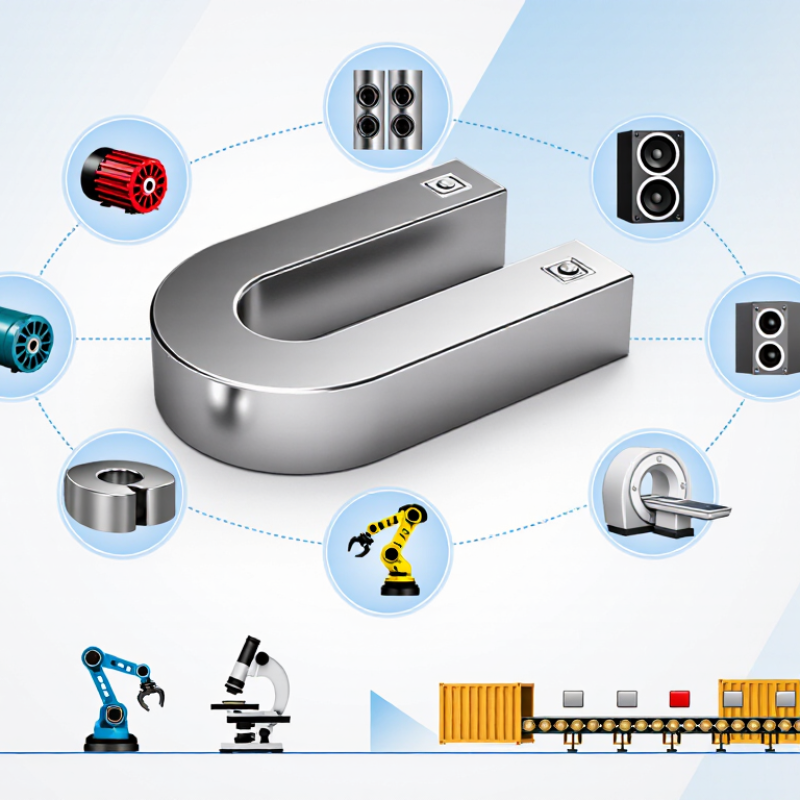
China’s strongest magnet market is moving beyond simple “highest grade” claims. Advanced NdFeB materials can reach 52UH in selected specifications, while some high-remanence products approach 1.4 tesla Br. These figures describe different performance characteristics. Br measures residual magnetic flux density. UH indicates high-temperature resistance and coercivity.
That distinction matters in engineering. A magnet with high Br can deliver strong surface flux in compact motors, sensors, and magnetic couplings. A 52UH grade is designed for demanding thermal environments, often around 180°C, depending on the applicable standard and manufacturer’s testing method. Real performance also depends on shape, coating, air gap, magnetization direction, and assembly design.
Numbers need verification.
Professional buyers should request complete datasheets, batch test reports, and temperature-dependent magnetic curves. Independent testing can confirm Br, Hcj, dimensional tolerance, and irreversible loss after heating. In practice, the strongest material is not always the best choice. High-performance grades may cost more, require tighter machining control, and show reduced output after surface damage or poor installation. Even the phrase “1.4 T Br” deserves caution, because it may describe a laboratory result, a specific composition, or a selected production batch. Supplier evaluation should include process consistency, traceability, and technical support. My own view is imperfect: headline grades attract attention, but stable magnetic behavior usually creates greater value over years of operation.
Anonymous supplier capability benchmark based on representative commercial sintered NdFeB grade families
| Rank | Capability Profile | Representative NdFeB Grade | Typical Remanence Br | Typical Coercivity Hcj | Maximum Energy Product | Recommended Maximum Working Temperature | Common Product Forms | Typical Application Focus |
|---|---|---|---|---|---|---|---|---|
| 1 | Ultra-high magnetic output capability | N52 | 1.42–1.48 T | 876–955 kA/m | 398–422 kJ/m³ | Up to 80°C | Discs, blocks, rings, segments | Compact motors, sensors, magnetic couplings, miniaturized devices |
| 2 | High output with moderate thermal stability | N50M | 1.40–1.45 T | 1,114–1,274 kA/m | 382–406 kJ/m³ | Up to 100°C | Blocks, discs, rings, custom assemblies | General-purpose motors, magnetic fixtures, industrial automation |
| 3 | High-grade performance with improved heat resistance | N48H | 1.37–1.42 T | 1,353–1,512 kA/m | 366–390 kJ/m³ | Up to 120°C | Arcs, segments, blocks, rotors | Automotive actuators, pumps, generators, industrial motors |
| 4 | High-strength, high-temperature capability | N45SH | 1.32–1.38 T | 1,592–1,751 kA/m | 342–366 kJ/m³ | Up to 150°C | Motor segments, rings, blocks, bonded assemblies | Traction motors, compressors, high-temperature actuators |
| 5 | Ultra-high coercivity capability | N42UH | 1.28–1.34 T | 1,990–2,149 kA/m | 318–342 kJ/m³ | Up to 180°C | Arcs, rotors, blocks, precision components | High-speed motors, aerospace systems, demanding industrial drives |
| 6 | Very high thermal and demagnetization resistance | N40EH | 1.25–1.30 T | 2,388–2,546 kA/m | 302–326 kJ/m³ | Up to 200°C | Motor arcs, rings, blocks, custom magnetic circuits | High-temperature motors, generators, oil and gas equipment |
| 7 | Extreme coercivity capability | N38AH | 1.22–1.27 T | 2,785–2,943 kA/m | 286–310 kJ/m³ | Up to 220°C | Segments, rings, blocks, engineered assemblies | Severe-duty motors, power-generation equipment, thermal systems |
| 8 | High-temperature stability with balanced output | N35AH | 1.17–1.22 T | 2,785–3,183 kA/m | 263–287 kJ/m³ | Up to 220°C | Arcs, blocks, rings, sensor components | Thermal actuators, industrial sensors, high-temperature machinery |
| 9 | High-coercivity industrial capability | N33AH | 1.14–1.18 T | 2,785–3,183 kA/m | 247–271 kJ/m³ | Up to 220°C | Blocks, rings, arcs, magnetic assemblies | Industrial motors, measuring equipment, separation systems |
| 10 | Stable high-temperature production capability | N30AH | 1.08–1.12 T | 2,785–3,183 kA/m | 223–247 kJ/m³ | Up to 220°C | Discs, blocks, rings, custom shapes | High-temperature sensors, holding systems, industrial equipment |
Technical values are representative ranges for commercial sintered NdFeB materials and may vary according to chemical composition, grain-boundary diffusion, manufacturing process, dimensions, coating, and testing standard. Actual operating temperature must be confirmed through magnetic-circuit design and application testing.
It indicates strong high-temperature resistance and coercivity. Performance may remain suitable near 180°C, depending on testing standards and construction.
Br means residual magnetic flux density after magnetization.
Not necessarily. Application design matters more than a headline number. Shape, air gap, coating, and magnetization direction affect output.
Compact motors, sensors, and magnetic couplings may benefit. High surface flux can support smaller designs. Assembly errors can still reduce performance.
Request complete datasheets, batch reports, and temperature-dependent magnetic curves. Independent testing should confirm Br, Hcj, dimensions, and heating losses.
Examine process control, production records, traceability, and delivery history. Ask for samples from different batches. Small variations matter.
Controlled sintering, precision grinding, automated magnetizing, and tight dimensional control are useful indicators. Technical support matters too. Polished claims are not enough.
Often, yes. They may require tighter machining, careful coating protection, and more controlled installation. The cheapest option can become expensive after failure.
High-grade neodymium supports compact, powerful designs. Samarium-cobalt often suits hotter assemblies. Ferrite and Alnico can serve cost-sensitive applications.
No ranking is perfect. Large output does not guarantee strong application support. Excellent prototypes may not prove urgent-volume capacity.
This article explores China’s Strongest Magnets market, with a focus on high-performance neodymium-iron-boron magnets reaching advanced grades such as 52UH and remanence levels of up to approximately 1.4 T. It explains how suppliers are evaluated through key indicators including maximum energy product (BHmax), intrinsic coercivity (Hcj), production capacity, ISO 9001 certification, export experience, dimensional tolerance, coating quality, and application suitability. The ranking presents ten leading supplier categories based on technical capability, manufacturing scale, grade availability, and quality-control systems, without focusing on brand names.
A detailed comparison covers Br, Hcj, BHmax, tolerances, surface protection, and common uses in motors, generators, sensors, renewable-energy equipment, and industrial systems. To support reliable purchasing decisions, the article also introduces verification methods based on ASTM A977, IEC 60404-8-1, material certificates, batch testing, and independent third-party inspection. This framework helps buyers distinguish laboratory performance from consistent, application-ready production quality.
